

Earlier this week, I saw a post from Schwarzman Scholar & valued mutual François Valentin I found interesting, from the Asian Development Bank paper Reducing Inequality in the People’s Republic of China through Tax and Fiscal Reforms;
It’s funny to me that leftists internationally fantasize about China when inequality there is higher than even in the United States In fact China’s tax and transfer system has virtually no redistributive effect.
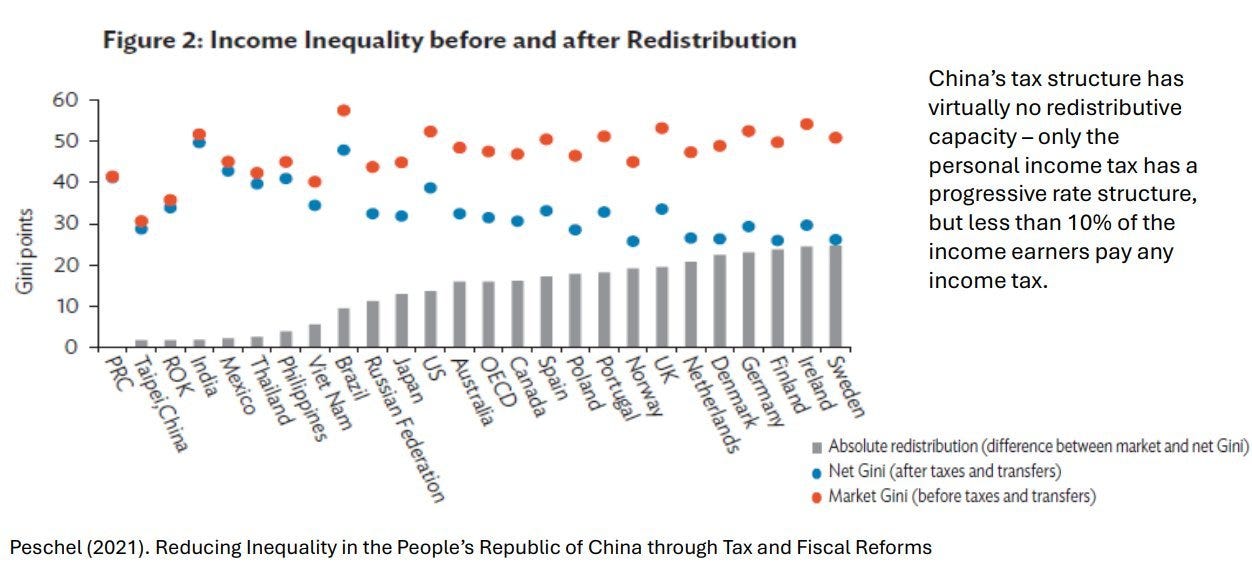
In fact, the most redistributive systems - if you use transfers from top 10% to bottom 50% - are the U.S. and Britain. But it doesn’t seem to be impacting inequality; a recent paper in Applied Economics has demonstrate that Europe’s lower inequality levels cannot be explained by more equalizing tax and transfer systems, because (after accounting for indirect taxes and in-kind transfers) the US redistributes a greater share of national income to low-income groups than any European country.
So what is China doing, if not redistribution? As Dan Wang writes in his new book, Breakneck;
China does little by way of redistribution from the wealthy to the poor; rather, it is enacting a Leninist agenda in which the state retains enormous discretion to command economic resources in order to maintain political control and to build toward a post-scarcity world.
In Breakneck Wang argues that China is ‘an engineering society’, as opposed to the ‘lawyerly society’ of the US and lays out how engineers have played a dominant role in shaping modern China. In response to the chaos of the Mao era, Deng Xiaoping elevated engineers to leadership positions across the Chinese government during the 1980s and 1990s. By 2002, every member of the nine-person Politburo Standing Committee, the highest authority within the Communist Party, had an engineering background. Hu Jintao, then General Secretary, specialized in hydraulic engineering and dedicated ten years to dam construction. Xi Jinping earned a degree in chemical engineering from Tsinghua University, China’s premier institution for science and technology.
Being engineers, Chinese leaders see infrastructure projects as a better form of social transfer. They have no intention, even when those infrastructure projects deliver a higher level of development, from altering from that strategy; in 2021 Xi Jinping said said, “Even when we have reached a higher level of development... we should not go overboard with social transfers. For we must avoid letting people get lazy from their sense of entitlement to welfare.”
What is unsaid throughout Wang’s book is that Chinese leaders do not have to worry about elections. Their strategy is not just about raising living standards, but a way to ensure legitimacy for their rule without needing to consult their people at the ballot box. The Sino system is to replicate the long-term material benefits of democracy, without replicating the representative elements of democracy that make it so attractive, as David Runciman notes in his 2018 book How Democracy Ends;
In place of personal dignity plus collective benefits, they promise personal benefits plus collective dignity.
This is the essence of what the ruling communist party of China is currently committed to delivering; personal benefits are underwritten by the state, which does what it can to ensure they are widely distributed.
Britain – as do most social democracies – focusses on delivering personal dignity plus collective benefits. The personal dignity is a feature of the democratic system; all voters have the right to have their concerns heard, and their vote counts equally at elections. Collective benefits, meanwhile, are generated by state redistribution of the wealth generated by the society as a whole through progressive taxation and comprehensive public services.
In recent decades non-democratic China has made greater progress in reducing poverty and increasing life expectancy than comparative nations that have adopted Western democracy (in particular India, which provides the most handy comparison). Of the two visions for future governance for developing countries – the continuation of liberal democracy, or Chinese style technocracy – the Sino system looks far more attractive.
Wang argues that the development of ‘the lawyerly society’ has resulted in America being unable to develop the infrastructure necessary to keep up with its own population growth, or sustain sufficient economic growth – something that is replicated in most modern liberal democracies, particularly those in Western Europe, which have developed a dangerous combination of vetocracy and massive immigration-derived population increases.
But there is now an increasing view that we should treat developed Western nations as developing. Breckneck’s conclusion sees Wang argue that in order to compete with China, America must recapture its desire and willingness to build; the abundance and progress movements in America are also, in some way, a rejection of the approach of the lawyerly society and an adoption of the engineering society’s approach to infrastructure. There is a similar desire to see Britain build again too; Anglofuturism.
While Aris Roussinos has offered some intellectual scaffolding, the movement largely lacks rigorous political philosophy. For most of its adherents, Anglofuturism is defined not by theory but simply by a singular focus on grand infrastructure projects. If there is to be an Anglo future, we have to get Britain building again - and that means treating Britain, if not quite as a developing nation, then as a nation that needs to be developed.
If we are to treat ourselves as such then, as the China vs India model proves, in terms of social transfer in developing nations capitalism with Chinese characteristics is preferable to social democracy. The underlying contention of Anglofuturism is that we must change our model of social transfer from prioritising collective to personal benefit. It’s Sinofuturism with Anglo characteristics.
That is not to say we must adopt China’s non-democratic tendency (disregard for personal dignity); simply shifting from a focus on collective benefit to personal benefit would be enough. Is this likely to happen? It’s questionable.
