

Many critics to the right would simply dismiss the Dinner Party Problem by arguing that the Conservatives were (and are, but I use the past tense for convenience) not truly a conservative party. They would argue that appeals to right-wing voters were a form of deception carried out by the Eternal Centrists in positions of power; a necessary but insincerely offered red meat quotient designed to keep the right-wing base satisfied whilst they pursued the liberal policies they actually believed in. Similarly, some would dismiss it as a symptom of political cowardice; the people who held power were simply unwilling to Do The Necessary.
But both dismissals share a common flaw: they refuse to engage with the practical realities of elite formation, or how the influence and incentives of office & power shape behaviour, and instead demand simple unbending ideological commitment. John Palmer’s comments on Shakespeare’s Brutus are bought to mind; ‘A fastidious contempt of the shameful means necessary to achieve his ends is the constant mark of the political idealist.’
Principled denial soon turns into practical blindness. What we are dealing with is not just bad faith or individual weakness but a structural problem in elite formation, which if we are to rebuild and future-proof right-wing governance requires consideration - and mitigation.
Under the current system, the right-wing elite is formed primarily of Oxbridge graduates, with a smattering from lesser Russel Groups. In the Parliamentary Party, approximately 29% of Conservative MPs had attended Oxbridge – a figure that’s still accurate, with another 40% coming from the Russel Group.
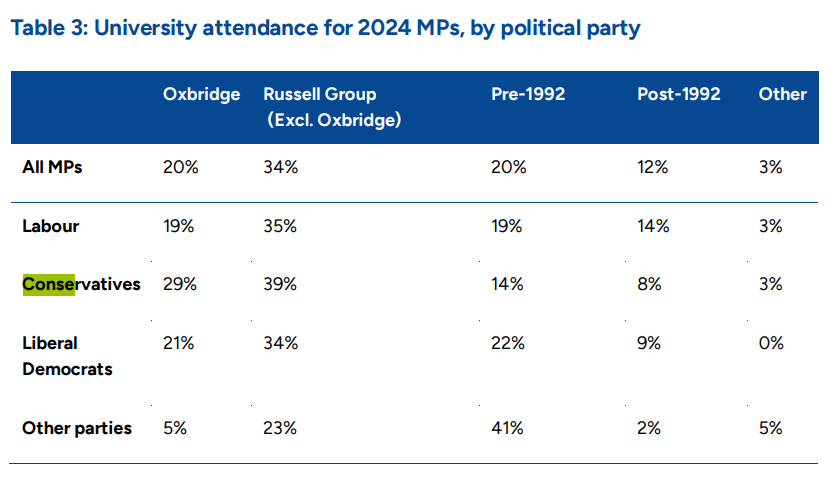
There is no data on the educational backgrounds of SPADs, but anecdotally the career path of Oxbridge to SpAd to MP to Minister has become increasingly common. Given the overrepresentation of both former SPADs and Oxbridge graduates in senior roles, it’s reasonable to assume that it now functions as a self-reinforcing elite pathway into power.
Graduates from elite institutions like Oxford and Cambridge are accelerated to staff right-wing governments because it serves as, essentially, a proxy measurement for both competence and intelligence (as well as a significant interpersonal network[1]). This would be fine, if the resulting elite formation had not largely proved themselves largely incapable of delivering right wing policies over the last 14 years. My fundamental assertation is that both the people and the system of selection we have developed leads to an elite formation that is simply too susceptible to the Dinner Party Problem.
The fear of social ostracism from long-standing friendship groups can be a huge deterrent to challenging entrenched norms. Attending an elite university may open doors, but it also raises the social cost of dissent: if your peers are destined to lead the Civil Service, the arts, or other institutions, the social (and possibly professional) cost of enforcing change in those systems is much higher than say, for me, who went to Hull and doesn’t know a single artist. What is the social cost for me to say I think we should defund the Arts Council? There isn’t any. A complete removal of cost means complete freedom of action.
This dynamic is reinforced by psychological factors. Individuals high in agreeableness are predisposed to defer, conform, and avoid confrontation, particularly under social pressure. In Personality and Political Attitudes, Gerber et al demonstrate that agreeableness affects political attitudes depending on the context. We are therefore constructing a highly vulnerable right wing political elite by drawing from social pools that select for high agreeableness – and therefore conformity, as I have previously written;
Personality traits are logically and demonstrably associated with different political leanings; studies have shown that agreeableness was significantly correlated with education, occupation, and childhood intelligence and that people in higher socioeconomic jobs tend to be more agreeable. So we are drawing from a pool of people with high agreeability; but further studies have shown that for high social class, left-wing orientation increased with agreeableness, compounding the problem of scale.[2] The informal talent selection network that exists on the right is therefore drawing on a small number of right-wing people who are predisposed to have high agreeability. Simply put, that makes it very difficult when you have to do disagreeable things.
A study in 2007 found that agreeableness contributes positively to academic success at university, a finding that’s been consistently repeated. Importantly, agreeableness was linked to group-based coursework and cooperative learning outcomes, which I understand are central to Oxbridge-style tutorials. Another study two years ago showed that agreeableness is positively associated with achievement in areas requiring collaboration and interpersonal engagement.
This shouldn’t come as a surprise, given agreeableness facilitates cooperation, conflict resolution, and peer acceptance. Yet while these traits make right wing governance more difficult, the right is still selecting for them. This is not just by overrepresenting people from elite institutions, but by using informal networks to identify and promote talent which, as former spads told the IfG, rely heavily on recommendations and connections within the party – meaning agreeability carries as much, if not more weight, than ability.
So, how do we solve the Dinner Party Problem?
What we have are private troubles causing public failures, because psychological vulnerabilities are manifesting as systemic problems. What we therefore need are systemic measures that can manifest as psychological solutions.
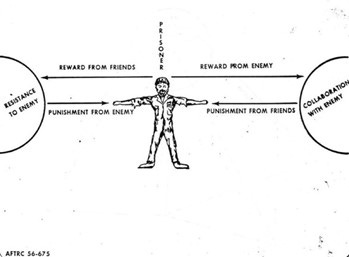
The diagram below is taken from Bruce Jessen, best known for the CIA’s enhanced interrogation techniques. Imagine the Spad or Minister as a prisoner of the political system. In order to ensure resistance to enemy (the Blob) we need to push them towards ‘resistance to enemy’. It’s relatively simple; we just need to increase/decrease the relevant push/pull factors.
The first thing we need to do is make the process of hiring right wing talent formal. The informal network, as we have seen, is by it’s very nature an entirely counter-productive selection process. Formalizing recruitment means establishing clear criteria and ensuring the pipeline of talent is rigorously assessed.
And by what criteria should we be assessing? Elite education is no longer a sufficient qualification. If Oxford and Cambridge have produced a generation that conforms to progressive norms, we must widen our recruitment pool. Oxbridge graduates are selected because their education serves as a proxy for intelligence and/or aptitude. But why bother using a proxy? Simply design intelligence and aptitude tests that filter for suitable candidates and are blind to their background. It’s not illegal to simply administer an IQ test on applicants.
And what should we be filtering for? Given the content of this piece, it’s clear I think we should be selecting future right wing talent not just on competence, but on traits. One of the easiest ways to increase/decrease the relevant push/pull factors on our political prisoner is to select people who have a profile that is predisposed to Do The Necessary. Part of this profile must be psychological; I suggest, as a beginner, the following – but reserve the right to change these recommendations once I’ve done more research.
Low agreeableness
High conscientiousness
High emotional stability/low neuroticism
Assertiveness
Integrity
Further, given the role elite institutions play in forming non-political elites, and the attendant social pressures this adds to political elites, we have to recognise the value of resistant to social punishment as a valuable political resource. Selecting people who have no ‘reward from enemy’ or ‘punishment from enemy’ factor because they have no relevant friends is a very easy win. Solve the Dinner Party Problem with this one neat trick; select people who do not care about being invited to dinner parties.
But where are they being hired to? I have previously written on the need for an institutional level of right-wing politics, and this is a system that must be fleshed out further. As an initial idea, however, you could centralise CCHQ hiring of all Tory staffers, to provide (relatively) safe and secure jobs to nurture future talent. You could do the same for council group political advisors outside of Westminster. In a conversation I had with Chris Bayliss recently, he pointed out one of the things the right does much better in America is find jobs for people when they’re out of power. An organisation that is interested in personnel, as Heritage is – for instance an expressly right-wing Civic Future, could provide that infrastructure, training fellows and then placing them.
There are also, given the social changes around mass participation in political parties, changes to selection that should be contemplated. If an increasingly unrepresentative membership are putting forward increasingly unrepresentative representatives, then this becomes a problem not of internal party democracy, but national; as Lasok observes, ‘a mass membership structure without a mass membership is the least democratic option of all’. There are alternatives. Reform’s model, for instance, is much more in tune with democratic politics as it currently functions; a spectator sport for low-engagement voters. The average voter now spends less than 5 minutes a day thinking about politics, and whilst their former sustained involvement allowed them to consume so much news they could follow political narratives, they now consume it only episodically (and, thanks to social media, increasingly so). Reform has grasped this well, and doesn’t demand anything from members; signing up to the party simply provides emotional satisfaction and identification. It is less a vehicle for mass membership than a stage for mass spectatorship; we can see shades of this in Labour’s surge in members under Jeremy Corbyn, and Emmanuel Macron’s En Marche! (now Renaissance), which does not require members to make a monetary donation. Macron has even suggested that members can join while simultaneously retaining membership in another republican party.
Ultimately, there is only one way to end the PPE state; stop selecting PPE graduates.
[1] Which can also be a problem, as there is also a bias favour of in-groups. Following the COVID-19 pandemic for instance, it was revealed that one in five UK government contracts for personal protective equipment (PPE) - worth a combined £4.1 billion - had been awarded to companies with personal ties to members of the Conservative Party, including connections dating back to university and private schooling.
[2] I don’t know why I didn’t reference this study properly at the time. Gerber et al found that high agreeableness correlates with more liberal political orientations.